Robyn Kinsela: upcoming artist-in-residence


Robyn Kinsela, 10pm, 2009, acrylic on canvas,120x240cm
This work is about spaces and sounds. I am investigating spaces and how they are occupied – even whether they are occupied. Walking after dark in bushy suburban areas, such as Mittagong where I live, I hear muffled voices and music, small nocturnal creatures and the sounds of the breeze. I see lights on in living rooms and moonlight through the trees. I hear my own footsteps. 10pm captures a sense of physical, manmade spaces or places nestled within a rugged overgrown bushland by expressing and identifying the sounds inherent in those spaces.  Silence is also one of those sounds.

Robyn Kinsela is interested in interpreting micro and macro textures as well as sounds found in the natural environment. She considers human presence and interference in the landscape and how it has been adapted and changed by people over time. Robyn’s work is created from drawing, photography and memory, then realised as paintings and works on paper, including digital prints. Robyn is interested in surface textures and patterns and the visual communication of the senses of sound and smell. Playing with ambiguities of reality, appearance and illusion, she hones away unnecessary detail in the search for the essential message or feeling through the use of form, colour, tone, texture, contrast, memory and experience.


Robyn Kinsela, Seeking Songlines, 2011, acrylic and oil on canvas, 81x81cm
Seeking Songlines is one of many recent works that I am developing in order to help me and others understand more about Australian Aborigines’ ancestral history, albeit in an abstract way. The European terms Songlines or Dreaming tracks are, to the Aboriginal, “Footprints of the Ancestors, or the ‘Way of the Law’”¹. What interests me is this idea of repetition of a shape, colour or texture, brought together to make a “whole” as in the painting and repetition of song, story and language through time, past, present and future, being brought together to make sense of a culture and history, another “whole”. (¹Bruce Chatwin, The Songlines, page 2, Picador, 1987)

My interest in the question of ownership of marks and mark-making, has led me to create my own library of visual references with strong influences from the work of other artists, cultures and art movements. By establishing a system of visual cues or symbols I am capturing the intensity of my sense of place. 

Whilst artist-in-residence at Gunyah, Robyn plans to continue her exploration of the landscape both past and present, and make new work for her two upcoming solo exhibitions: Depot II Gallery, Sydney, in December 2012; followed by M16 Art Space, Canberra, in 2013.


Robyn Kinsela, Silence and Sadness, 2011, acrylic and oil on canvas, 122x61cm
Part of the West of Wilcannia series, this work happened after a visit to Kinchega shearing shed. The lost and forgotten memories of people from the past are heavily embedded in the old, worn and weathered boards of the shed. There is a fogged over window before which bottles collecting years of dust sit clustered as a tribute to the past. The misty, dusty light showing through the panes of glass of the window and then though these bottles, unites to present a beautiful, peaceful, hazy glow within the warm darkness.  The silence of this scene is pays homage to those who once occupied this environment and I wanted the simplicity of that reverence to be mirrored by the simplicity and calm of the composition of the painting.


“There’s a point where you’ve got to interpret the world, not make a replica of it.” 
(David Hockney)


Robyn Kinsela lives in Mittagong and teaches painting, drawing and digital imaging at Goulburn and Moss Vale TAFE. She has studied Architecture, Industrial Design and Art Education, and was artist-in-residence at the Hungarian Multicultural Centre, Lake Balaton, Hungary, in 2007; and artist-in-residence in the Furniture and Design Workshop, ANU School of Art, Canberra, from 2001 to 2006. Robyn has held over 13 solo exhibitions since 1986, the most recent being West of Wilcannia at Form Studio and Gallery, in Queanbeyan. She has also participated in many group exhibitions and has been a finalist in the Fisher’s Ghost Open Art Award, Outback Art Prize, Adelaide Perry Drawing Prize, Norvill Landscape Painting Prize, Heyson Landscape Prize, Banyule Works on Paper, Arc Yinnar Drawing Prize, The Island Art Award Tasmania, Geelong  Print Award, Hazelhurst Works on Paper Art Award and the 33rd Alice Prize. As an active member of the Southern Highlands Printmakers, Robyn has exhibited in Goulburn Regional Gallery, Campbelltown Regional Gallery and Wollongong City Art Gallery. Her work is also included in the Vario Print Exchange, which travelled to Wales and Hawaii. Robyn’s work has been collected by the National Gallery of Australia, National Gallery of Wales, NSW Historic Houses Trust, Westmead Children’s Hospital and Canberra Hospital public collections, as well as various private and corporate collections in Australia, USA, UK and Hungary.

You can see more of Robyn's work on her website www.robynkinsela.wordpress.com

Linda Swinfield: artist-in-residence July 2012

Linda Swinfield, Walk 1, 2012, pastel and charcoal on paper

The Gunyah AIR was for me a sincere time of quiet reflection, away from my hectic life of work and everyday existence. I didn’t want to leave its location and beauty. This was a period for me to be only a mother and an artist, it allowed me to reflect upon future directions as an artist and teacher and re-ignite a variety of tangents within my art practice that are often pushed aside in the outside world.

Linda Swinfield, Composite studio two, 2012, Lomography*

We enjoyed the regular company of the kookaburras at dusk, with the occasional magpies and butcher birds competing for treats - accompanied by squeals of delight from Sid. We also listened to the possums on the roof most nights and enjoyed watching the wallabies in the bush in the afternoons.

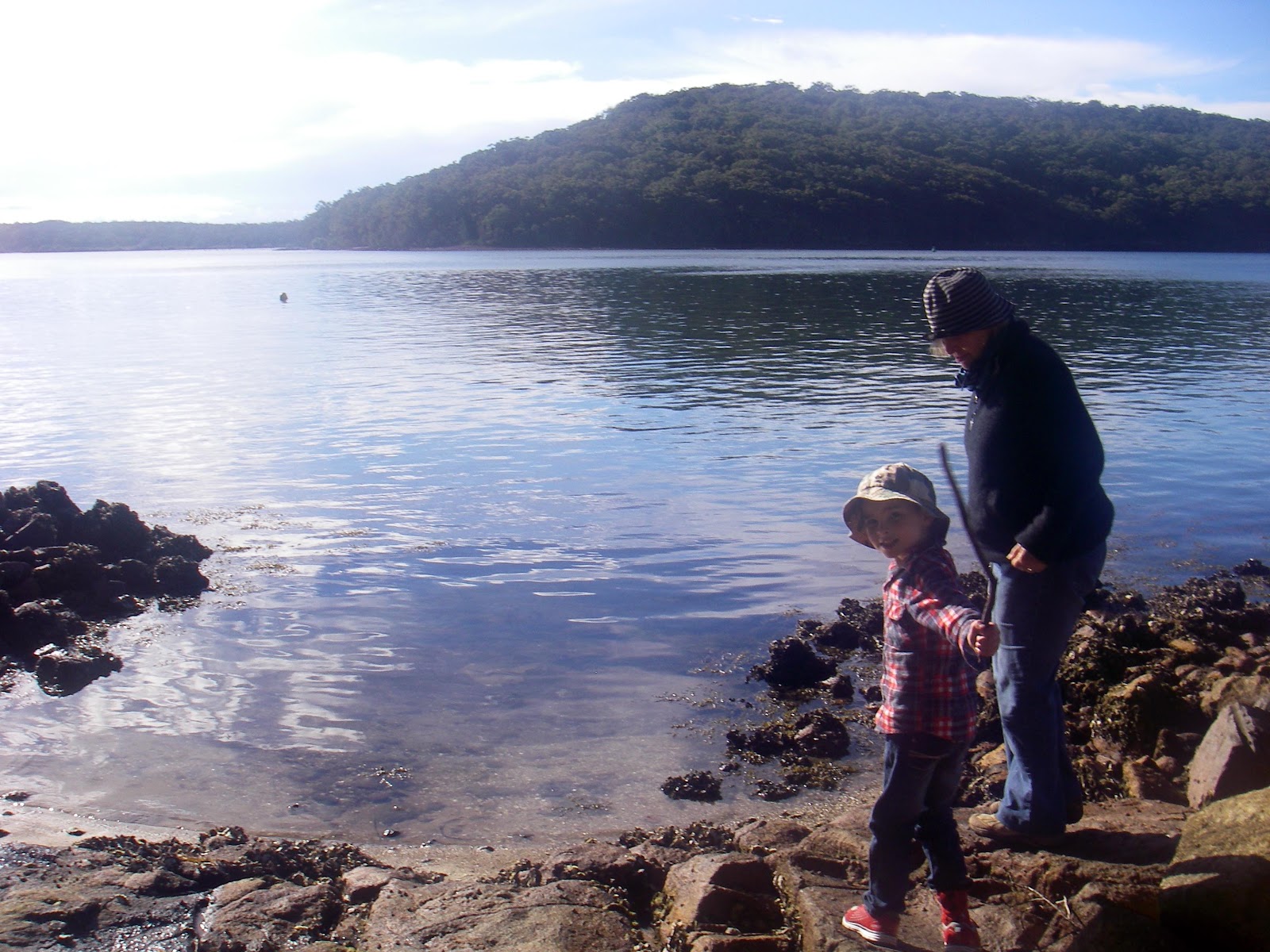
Linda Swinfield, Trisch and Sidney at the water’s edge, 2012, digital photography

My original proposed goals were a little forgotten and I commenced by drawing in sketchbooks. This included images of seaweed, oyster shells, and a variety of sea treasures we found on the water’s edge, some natural and others manmade. I researched some of the symbols and motifs borne out of these scavenger hunts along the waterways. 

Linda Swinfield, Seaweed drawings, 2012, pastel, charcoal and chalk on brown paper
Linda Swinfield, Composite textures, 2012, Lomography*

We went on daily bush and beach treks and had little adventures including a renegade trip to the historic cemetery in Carrington, two trips to Tea Gardens, as well as a day trip to Great Lakes Museum and a lunch with friends in Karuah.

Linda Swinfield, Cemetery Carrington, 2012, digital photography

I drew daily with a variety of materials, and kept a small diary of drawings and notes about our daily events. The drawings extended into dremmel drawings into plywood and carved linoleum blocks that I am yet to print.

Linda Swinfield, Water movement, 2012, digital photography

Towards the end of our stay I created larger and more finished drawings that were interpretive and a less literal response to the site. Through these works I attempted to capture some more ephemeral aspects of the landscape walks, trails and small frames of sight lines or views formed through the trees. I was quite captivated by the layers of textures within the bush, along the waterline and hope to incorporate them into my print making processes in the future.

Linda Swinfield, Diary page two, 2012, charcoal and pencil on paper

My interest in history prompted me to research the area’s past and its connection to Walter Burley Griffin. I found his original drawings online and then discovered some of the original signposts in the bush around the cove.

Walter Burley Griffin, City of Port Stephens, 1918/19
National Library of Australia
North Arm Cove was the site for Walter Burley Griffin's great city (the New York of Australia), planned in the expectation that Port Stephens would become the main seaport for New South Wales. The land was purchased by Henry F. Haloran, land developer and surveyor, but the city never eventuated. Plans for the city show two railway stations, a business district, Federal and State office sites, a factory district, car parks, wharves, parks and playgrounds. The subdivision commenced in 1918, the outline of which can still be seen from the air.

Linda Swinfield,  Trees with texture at the water's edge, 2012, digital photography 

On our daily walks we took hundreds of photographs, both digital and with an old plastic 35mm film camera that I purchased at Vinnie’s for $1, prior to the residency. This camera enabled Sidney and I to play with Lomography*, our experiments created spontaneous images with surprising results.

Linda Swinfield, Composite studio one, 2012, Lomography*

Three friends assisted me at the Gunyah AIR, without them my time here would not have been as productive. Revisiting was Emily Valentine Bullock who travelled up from Sydney, Patricia Wilson Adams (Pandora Group Artist) also stayed, and Emilie Tseronis visited and took Sid out for playtime with other children.
Linda Swinfield
August 2012

Linda Swinfield, Emily and Sid toasting marshmallows, 2012, digital photography

*Lomography is a term coined in the 1990s, referring to the use of a cheap film camera to take experimental creative photographs. According to www.lomography.com there are 10 rules that define ‘lomography’:
~ Take your camera everywhere you go.
~ Use it any time – day and night.
~ Lomography is not an interference in your life, but a part of it.
~ Try to shoot from the hip.
~ Approach the objects of your Lomographic desire as close as possible.
~ Don’t think.
~ Be fast.
~ You don’t have to know beforehand what you captured on film.
~ Afterwards either.
~ Don’t worry about any rules!
Linda and Trisch by the fire, 2012, Lomography*, photograph taken by Sidney Swinfield

You can find out more about Linda's practice at 
and 
www.lindaswinfield.wordpress.com  
and 
www.thepandoragroup.blogspot.com.au                                                                                                                     

Port Stephens Diary of Natural Events - August


An extract from Michael Smith's "Port Stephens Diary of Natural Events"...

AUGUST

Eastern Rosellas engage in courtship.
Echidna egg hatches and young attach to a teat.
Cup Fungi appears.
Bandicoots start breeding.
Occasional snow on Barrington Tops.
Wattle Day, some wattles are in bloom.
Cup Moth cocoons on gum leaves.
Young foxes start exploring and playing.
Pee Wees start building their mud nests.
Dagger Hakea in flower.
Antechinus mate.
Male Brown Antechinus die, leaving the females to raise the next generation.
Koels arrive from Papua New Guinea to lay eggs in other bird's nests.
Kookaburras lay two eggs.
This year's baby Quolls become independent.
King crickets lay eggs in Banksias.
Gnat orchids are in flower.
Painted Lady Butterflies emerge.
Pardolotes dig nest burrows.
Welcome Swallows arrive.
Euphrasia Collina is in flower.
Butchers Birds are active.
Koala cubs leave the pouch and climb onto their mother's back.
Donkey Orchids are in flower.
Mosquito wrigglers are abundant in pools of water.
Ducklings can be seen walking to water.
Reed Warblers return from the north.
Pallid and Bronze Cuckoos call.
Cormorants begin nesting.
Potato Orchid flowers open.
Greenhood Orchids everywhere.
Quoll babies are grown up.
Fairy Penguin eggs hatch on Broughton Island.
Wading birds arrive from Siberia (Stints, Curlews and Sandpipers).
Flies overwinter as lavae and pupa in crevices.
Rulingia hermannifolia in flower behind Kingsley Beach.
Gymea Lily in full flower.
Spring has started.
Sawfly grubs cluster on Eucalypt leaves.
Pixie Cap Orchid and Greenhood Orchid have reduced to just leaves on the ground.
Pink Finger Orchid in flower.
Yellow Robins nest.
Skipper Butterflies appear.
Milkmaids in flower.
Sugar Glider twins are born.
Cuttlefish come close to shore to breed in the shallows.
Oystercatchers start to breed.
Red Wattlebirds depart.
Michael Smith, 1999


Emily Valentine Bullock, Cast of Crabs - North Arm Cove, 2011
Emily Valentine Bullock, Cast of Crabs - North Arm Cove, 2011