Port Stephens Diary of Natural Events - December/January


An extract from Michael Smith's "Port Stephens Diary of Natural Events"

DECEMBER
Beard Heath develops berries.
Oyster spat is collected.
Mud Dauber Wasp makes its nest.
Jacaranda blooms cover the ground.
Half of the Christmas Bush flowers have turned red.
Lobelia gibbosa, Mountain Devils and Apple Berry are in flower.
Broad Leaf Geebung is in flower.
December to January is peak birthing time for Koalas.
Handsome Flat Pea seed pods explode.
Jewel Beetles and Scorpion flies appear on blossoms.
Christmas Beetles fly against windows at night.
Shark egg cases and bluebottles wash up on beaches.
Pigmy Possums have their young.
Flies breed and multiply.
Christmas Bells are in flower.
Young Wombats are 6 months old, fully furred and leave the pouch.
Saw Banksia is in flower.
Nests are full of baby birds.
Gymea Lily flowering stalks begin to grow.
Kookaburra chicks are fully independent.
Baby Brushtail Possums peeking out of their mother's pouch.
Blue Wrens are seen more often.
Mosquito populations breed up.
Dagger Hakea is in flower.
Bark of Angophera costata litters the ground.
Prostanthra densa is in flower on the cliffs.
Wombat Berry is in fruit.
December 22nd, Summer Solstice, longest day of the year.
Bushfire season.
White-fronted Terns visit from New Zealand.
Ant Lions transform into Lacewings.
Some Grass Trees are in flower.


Britta Stenmanns, Port Stephens Lookout, 2011, photograph
Gunyah artist-in-residence 2011

JANUARY
This is a month of moulting, the casting of fur, feathers, skin, leaves and bark.
Gymea Lily sends up flowering spikes, they will take months to form.
January is the peak time for snake births, 90% will die in the first year.
Scribbly Gums are finished moulting and have clean snowy/creamy bark.
Dragonflies mate.
Toad fish are washed up on the beaches.
Mountain Devils in flower.
Young Ravens leave their parents' territory to establish a territory of their own.
Baby Koalas are born.
Sarsaparilla Vine Smilax glyciphylla is in fruit.
Some Banksias are dripping with nectar.
Young sugar gliders leave their parents to fend for themselves.
Eastern Grey Kangaroos give birth.
Goannas lay eggs in termite nests in trees.
Bluebottles wash up on the beaches.
Tern and Dotterel chicks can be seen running across the sand.
Scorpion Flies appear around flowers, the male offers the female a fly.
Christmas bells flower in the wetlands.
Big Mud Wasps fly about building nests.
Mutton Bird chicks hatch on Broughton Island.
Green Tree Frog is breeding.
Snakes escape the heat by hiding in deep crevices.
Swifts feed on flying ants.
Grebes build floating grass nests in the wetlands.
Mongolian Dotterel arrives from its Siberian breeding grounds .
Young foxes leave their mother's den to find their own territory.
Breeding time for many species of lizard.
Wanderer butterflies and Ladybird beetles about.

Michael Smith, 1999

Michelle Heldon: artist-in-residence November 2012


Michelle Heldon, Working with shells on the Gunyah foreshore, 2012

My time spent at Gunyah was beautiful. My first reactions were to the house! The Gunyah residence sits surrounded by gum trees facing the sparkling water. Amazing location - but it was the warmth and uniqueness of the house itself that captured me. I felt right at home with the log walls and skylights and lofts and window-seat! My ideal home... stepping down into the studio was also a delight to see it was right at the bush level with wall to floor windows looking out to the sea. 


Michelle Heldon, Gunyah studio, 2012

The vision of my residency was for it to be a parallel with my residency in Lapland Finland exactly a year earlier. I thought it would be interesting to see the differences in climate and discovery in Australia, a place where I have spent most of my life, from Finland, a completely unfamiliar landscape and climate. 

Michelle Heldon, Leaf line with Gunyah behind, 2012

I was expecting a lot of differences, the most obvious being the temperature, however I was surprised by some of the similarities in my discoveries. One of these surprises was that I was expecting a lot more consistency in Australia - that the landscape would not change very dramatically. 

Michelle Heldon, Ripple stones, Gunyah 2012

In Finland, I watched the lakes slowly freezing changing every day and the snow fall creating a whole new landscape over night.  At Gunyah, it was the discovery of the tide and how dramatically the landscape could change with that. So many of my discoveries were made from spending a few hours on the beach or a rock and watching - a whole new world would be revealed! 


Michelle Heldon, Shell adorned shoe, Gunyah 2012

I adapted the same process as in Finland, Going out into the surround area everyday and collecting, recording discoveries from that particular day. Like a diary I would reflect back on the day in the studio in the evening, capturing a few aspects that had an impact on me, with pencil on wood drawings. 

Michelle Heldon, Waternest drawing, Gunyah 2012

In Finland I used watercolour on paper.  These mediums I felt reflected something of the landscape and climate. Finland with its lakes and ice and Australia with is dryness and warmth.  Again, paralleling Finland, I made detailed watercolour paintings of the flora in the area. Just like in Finland, at Gunyah, this was quite a meditative process to sit with the amazing tiny uniqueness of the plants that easily are admired from afar but not often studied in detail.


Michelle Heldon, Seaweed tree and Seaweed tree drawing on chair, Gunyah 2012

During my time at Gunyah I also spent time making site specific works out in the landscape. I've always loved the work of Andy Goldsworthy and have enjoyed reading about his experiences making transient art in nature. I did a little of 'drawing' or forming lines on the frozen lakes in Finland but I did many more at Gunyah as I could spent a lot more time outside. These works resonated with me the most. I felt it really was an honouring of these wonderful details I was being captured by. 

Michelle Heldon, Leaf pond, Gunyah 2012

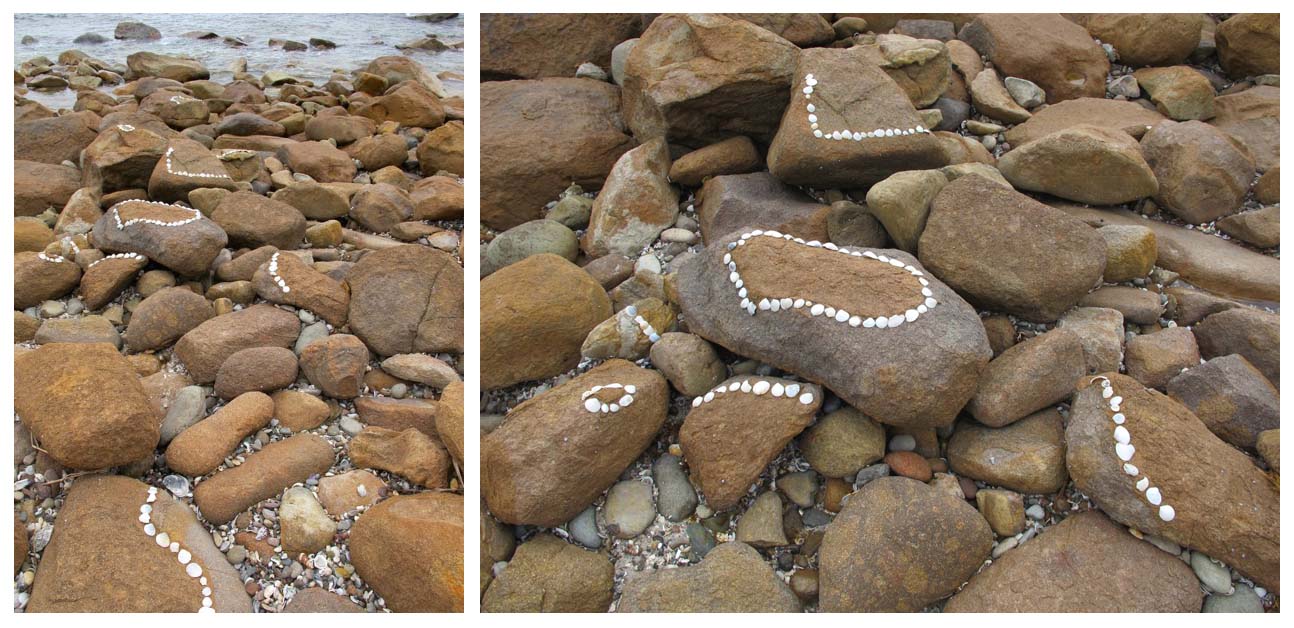
Rearranging white shells to highlight naturally formed patterns on the rocks. 

Bringing together strands of seaweed to create a line out to the sea. 

Collecting white driftwood and letting it rest in the amazing creases of a revealed rock shelf. 

Using Casurina needles to gently sit like little nests in the mini rockpools. 


Michelle Heldon, Highlighted rocks, Gunyah 2012

It's poetic I think, that these works sit in nature for just a short period of time and then, with the shift of the wind or the incoming tide, disappear and return to their surroundings. They remain only in the photographic record and my memory of the creation process.  


Michelle Heldon, Working in the Gunyah studio, 2012

It was wonderful to sit and look at the Gunyah work along side my Finland work - I hope to bring this together in an exhibition next year. Thankyou to Gunyah for hosting me, I had an amazing time.


Michelle Heldon
November 2012


Michelle Heldon, Dyl Rocks, Gunyah 2012

To read Michelle's Gunyah proposal and see images of her work in Finland go to www.gunyah.blogspot.com.au/2012/10/michelle-heldon

Beyond Eye Level: an exhibition by recent artist-in-residence Robyn Kinsela


Robyn Kinsela
Beyond Eye Level
4 - 15 December 2012
Depot II Gallery, 2 Danks Street, Waterloo NSW


Recent artist-in-resident Robyn Kinsela is exhibiting paintings from her time at Gunyah, in her solo exhibition Beyond Eye Level, at Depot II Gallery, Danks St Waterloo. Read her residency report at www.gunyah.blogspot.com.au/2012/10 and find out more about her practice at http://robynkinsela.wordpress.com

Robyn Kinsela, Viewpoints, 2012, mixed media, oil and acrylic on canvas

"I have painted the micro and macro textures and sounds that are “found” in our own environments. These textures are sometimes the result of our human “interference” with the natural but they all make up our familiar environment. We often don’t take the time to stop to take notice of things. It is important to me that my paintings are without obvious tangible subjects, that they are built around the intangible, derived from our senses of sight, sound, smell, touch and even taste. These, of course, all rely upon memory and experience."  
Robyn Kinsela,  2012

Robyn Kinsela, Viewpoints, 2012, mixed media, oil and acrylic on canvas

Outside the box: an exhibition featuring work by previous artist-in-residence Linda Swinfield


Linda is exhibiting drawings created during her Gunyah residency, in Outside the Box, a Pandora artists group exhibition at Moree Plains Gallery.


Linda Swinfield, Gunyah xi - Cove, 2012,
pastel and charcoal on paper, 38 x 43 cm

Outside the box: Pandora artists

1 December 2012 - 15 January 2013


Pandora artists are a group of Hunter Valley abstract artists who first exhibited together in 2006, at the Newcastle Art Space. Artists include Sally Bourke, Helen Dunkerly, Annemarie Murland, Linda Swinfield, Lezlie Tilley and Patricia Wilson-Adams. www.thepandoragroup.blogspot.com.au  

Moree Plains Gallery
25 Frome Street, Moree NSW 2400


Find out more about Linda's residency at Gunyah www.gunyah.blogspot.com.au/2012/08
More information on Linda's practice www.lindaswinfield.wordpress.com  

Applications for 2013 Gunyah artists-in-residence


Applications for the 2013 Gunyah artist-in-residence program are currently open. Applications close: 30 November 2012

The 2013 program will feature a one or two week residency each month, from March to October. Visual artists, writers, composers, performance artists, curators, new media, arts administrators and other creative types are welcome to apply.

Please read all the information "About Gunyah artist-in-residence program" www.gunyah.blogspot.com.au/p/about.html before applying. And please note that there is a residency fee of $220 per week (or part thereof) and that you'll need your own vehicle to access the North Arm Cove area.

To apply email Kath kathfries@gmail.com with:
  • Your contact details: name, phone, email, postal address; (select one contact person for collaborations and groups)
  • What you plan to do during your residency (max 200 words)
  • Bio and artist statement for each artist (max 200 words)
  • Url link for each artist (where possible)
  • Visual artists - attach up to 3 jpeg images of artworks per artist. Include an image list with artist name, title, date and materials for each work.
  • Other artists - attach a jpeg photo of yourself  
  • In order of preference list three possible dates between March and October 2013. Either with a start date and end date - start on a Monday and end on a Monday, or start on a Friday and end on a Friday. Or if you are flexible with dates please list three months in your order of preference.

All applicants will be notified in January 2013 regarding the success of their application. The selected artists' proposals and images will be posted on the Gunyah blog after the artists have been confirmed. 

Applications close: 30 November 2012


Please email Kath kathfries@gmail.com with any questions about your application.

Gunyah

Port Stephens Diary of Natural Events - November


An extract from Michael Smith's "Port Stephens Diary of Natural Events"

NOVEMBER

Most birds start to moult.
Black Faced Cuckoo Shrike are in abundance.
Crane flies emerge.
Baby Echidnas are 10 cm long and become too spiky for the pouch.
Dingo pups, aged 4 months, make their first outings into the outside world.
Whales are seen heading south.
Lacewings hatch.
Angophera costata sheds its bark.
Blueberry Ash starts flowering.
Prawns wait for rain to go to sea.
Trigger plants are now common.
Young magpies are being fed.
Wood-swallows nest after migrating south.
Blue Flax Lily has purple fruit.
Flying Duck Orchids abound.
Apple Berry and Lobelia gibbosa are in flower.
Sugar gliders leave the nest for the first time.
Antechinus babies ride their mother's back while she goes hunting.
Crimson Bottlebrush is in flower.
Broad Leaf Geebung fruit drops to the ground.
Scribbly Gum sheds it bark.
Flying Ants swarm on a hot day.
Stink bugs appear on Lemon Trees.
Galahs have their annual moult and their young become independent.
Red Jellyfish appear in the waters of Port Stephens.
Baby foxes are born.
Hungry Noisy Miner chicks chirp from the trees.
Red Ichneumon Wasps are common.
Quaking Grass grows its seed head.
Phascogale young are free to roam about.
Gulls moult their primary feathers
Eastern Rosella young are out of the nest and demanding to be fed.
Muttonbirds lay their eggs on Broughton Island.
This is a good time to collect seeds from the bush.
Grasshopper plagues begin.
Butcherbird young hatch.
Scribbly gums are in flower on Gan Gan Hill.
Antechinus babies are independent.
Wild Parsnip is in flower.

Michael Smith, 1999

Shuffle Shuffle, Gunyah 2012, 
Thomas Hungerford, Kate Brown, Anastasia Freeman, Michelle Genders, Robin Hungerford and Renee Oldfield

Caelli Jo Brooker and Andy Devine: artists-in-residence October 2012

Andy and I participated in the Gunyah artist-in-residence program in late October 2012, looking on it as an opportunity to share a creative resting place. We came to the residency with plans for using our time towards existing exhibitions, but once there we were inspired to use the Gunyah setting as a starting point for new work instead.

Caelli Jo Brooker, Gunyah studio diary, October 2012

We didn't have to go too far for subject matter... I found myself translating the shapes of boat hulls, rope, aerial views, landforms, strands of seaweed, and clustered organic objects as macro and microcosmic parallels were revealed between local lines and forms. Andy recorded the shapes, silhouettes and shadows of the landmasses viewed across the water, and we combined our interpretations in collaborative painted panels and drawings. Printing plates were made for combination and resolution in the print room at a later stage, and pages were made for an artists' book. Once we found ways to integrate our contrasting approaches, this collaborative process became a significant outcome of our studio time at Gunyah, and we hope to exhibit the resulting work in the near future.

Andy Devine, Gunyah studio diary, October 2012

Gunyah itself is a real treat nestled in the bush, with views through trees to the water and plenty of retro architectural charm. The location affords unique opportunities for both social and solitary time and Andy and I spent time exploring the waterfront individually before the weather suggested we move back inside to the shared studio space. Here, away from work and distraction, we spent most of our studio time making and un-making each other's work in to new configurations, as we arranged and rearranged and passed painted panels back and forth. When our families joined us on the weekend, Gunyah was perfect for sharing meals and conversation around the big dining table. We very much appreciated our opportunity at Gunyah - to escape, experiment and explore making work in such a wonderful location.
Caelli Jo Brooker, October 2012

Caelli Jo Brooker and Andy Devine, Gunyah collaborative works in progress, October 2012

Caelli Jo Brooker and Andy Devine first became friends when they shared a studio during their post-graduate fine art studies at the University of Newcastle. Since then they have worked together on many projects as gallery committee members, curators and exhibition participants. They planned to use their Gunyah residency to build on this, strengthening and maintaining their artistic connections, to collaborate on work and recreate their supportive studio atmosphere for generating ideas, discussion and critique. For more information on Caelli's practice please see www.caellijobrooker.com and for Andy's practice  see www.andydevine.com.au 
To read their Gunyah residence proposal please click on this link