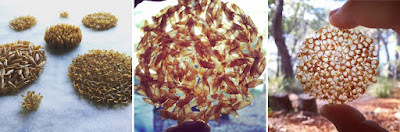
Lesa Hepburn: artist-in-residence Sept 2016

Lesa Hepburn, Working in my journal under a work in progress on the Gunyah shore

"Fossicking for fungi, drawing with pigments from eucalypt resin and sitting each evening with a warm glowing fire and reviewing my images of the day. These are some of the deep impressions left with me after my residency at Gunyah. I got back into making simple marks on my papers, bringing a supply of my handmade cotton rag paper and experimenting with found pigments and implements.

Lesa Hepburn, Black ink and tree pigment drawing on cotton rag paper. Gunyah 2016

Over the two weeks, Gunyah, North Arm Cove and Port Stephens gradually unfolded all their offerings as I became more aware of feathers, flowers, fibres and fishing. I investigated “a line in the water” from the jetty, on the shore and from our little Heron dinghy as we sailed from North Arm Cove towards Lemon Tree Passage. We watched dolphins in the evening, small stingrays at the beach and wallabies in the Gunyah Garden.  Some mild fishing success brought us face to face with unusual creatures.

Lesa Hepburn, A line in the water - Heros Bay, 2016


I spent much time each day and evening continuing my string making (video) and taking full advantage of the varied lights, textures and colours of gunyah and surrounds. Seeing my string sculpture in different ways each day has been most fulfilling.

Lesa Hepburn, Conversation in progress, Gunyah 2016

I made new papers, new string works and combined these in and around some of my favourite trees including the casuarinas on the Gunyah shoreline, where I also took time just to sit and absorb the surrounds and record some of these feelings in my journals.

Lesa Hepburn, New works in progress, Gunyah 2016

I have returned home with new visions, new techniques and materials and a refreshed appreciation of the natural environment and our interactions both at Gunyah and at home in Scarborough. I had time to refine my works and to become more precise with some of the ideas and forms that have been on my mind for a long while."


Lesa Hepburn 
Gunyah residency report
September 2016

Rebecca Waterstone: upcoming artist-in-residence

 Rebecca with her beeswax and oil works at her 2016 exhibition ‘Ethereal’, in Sydney.

Rebecca Waterstone is an artist and teacher currently based in the Blue Mountains. She has recently returned to Australia from Scotland where she taught, ran a gallery on the Isle of Skye and was Vice Chair of the Board of ATLAS, a contemporary art organisation on Skye supporting artists to make extraordinary ideas happen in the landscape. Rebecca is currently studying Masters of Art by coursework at UNSW Art and Design and was a finalist in the 2016 Tim Olsen Prize for Drawing.

Rebecca Waterstone, mixed media drawings in embroidery hoops

Rebecca's work makes connections between dualities of place both physical and imagined. Exploring location, distillation, edges and colour, she works across drawing, painting, photography, with wax, film, sound and scent. She seeks to draw attention to opacity and translucency, absorbed and reflected light that can be contained within the surface of the picture plane. Layers of veiled, minimal imagery creates a tension between obfuscation, containment and revealing of information. Veils of colour and topographical mark-making sit below the surface. Rebecca's works seek to resonate with the viewer and evoke a concentrated sense of experience.

Rebecca Waterstone, The Lost and Found, cast beeswax and oil paint with eucalyptus oil,
with Camden Cooperative NSW butterbox lid found in Scotland

During my residency, I plan to explore the area, ‘tap into’ and also re-connect with the essence of the location. My work is concerned with a deep sense of place, and having spent all my childhood holidays in Port Stephens, I have a strong connection here and it has special significance for me. I'm looking forward to delving into the area again and discovering how how this will evidence itself in my work. I plan to gather visual, geographical, topographical, elemental and weather-specific information focusing on materiality as a metaphor for experience of a place. The change of environment will give me a fresh perspective, responding to locations that are on the edge of coasts or mountains, and having recently returned to Australia from Skye, the idea of the ‘antipode’ resonates strongly - as Scotland and NSW are diametrically opposite points, connected by a straight line through the centre of the Earth.


Bridget Kennedy: artist-in-residence August 2016

My time spent at Gunyah was an opportunity to sync back into my natural life rhythm. Without the daily demands of a family and gallery business, or the distractions of city life, I found myself early to bed, early to wake, without the need to eat until lunch time, no desire for alcohol or sugar.

Bridget Kennedy, Gunyah jetty
The location gave me the space to spread out creatively, both mentally and physically, with working areas for specific projects spread throughout the house. I was able to freely move from one project to another as my mood  directed. It was a rare moment of time to fully focus on my practice and the process of creativity. I found the time to submit an exhibition proposal to a gallery in Victoria, finished the next step of my ‘choice mate’ project, commenced a new body of work, caught up on reading and took the first steps to curating a group exhibition. 

Bridget Kennedy, work in progress, Gunyah 2016
When I recall my time at North Arm Cove I think of the ‘ghost roads’….the memory of driving slowly along a road that existed on maps, but that led directly into mangrove swamps, the formal grid like imprints on the bush landscape with their suburban streets, circuits and parades, echoing the past ideas of Walter Burley Griffin and his plan for North Arm Cove as the possibility for the Nation’s Capital.

Bridget Kennedy, work in progress, Gunyah 2016
Bridget Kennedy
Gunyah residency report, August 2016

Lesa Hepburn: upcoming artist-in-residence

Lesa Hepburn


Lesa Hepburn is a botanical fibre artist, based in Scarborough, Queensland. Working with handmade paper and plant fibres, she makes installations, prints and architectural commissions. Lesa has a Bachelor of Visual Arts from Queensland College of Art, over the past ten years she has exhibited widely throughout north-eastern Australia. Lesa's work is informed by her life traveling and living in the tropics. She was born in Batu Gajah, Perak, Malaya and grew up in Sarawak immersed in a world of jungles, Dayak handcrafts, tropic shores, Super 8 home movies, markets and frequent travel by ship and plane to and from Australia. 

Lesa Hepburn, Purely Bast, 2016, hibiscus timber and letterpress on hibiscus bast fibre 

Lesa’s interest in local materials, foraging, making do and sustainability is reflected in the way that she embraces naturally available plant fibres, low energy processing and hand working techniques. The plants that inhabit the sub-tropical coast, where Lesa lives, form the core element of her work as a botanical fibre artist. Lesa has developed techniques preparing fibres and carving timber from the Beach Cottonwood (hibiscus tiliaceous) - a widespread littoral species in the western pacific and south east Asia. She twines the fibres with fine wire to create expandable and scalable sculptures. Lesa also works in print with letterpress, blind embossing, hikikakegami (a Japanese fibre printing technique), digital print media, and using hibiscus fibres twined into string to create embossing  impressions on handmade paper. 


Lesa Hepburn, Recoil 1, 2016, hand coloured blind embossing on handmade cotton paper

During my residency at Gunyah I plan to watch the water change with tides and weather, sail in our small boat and begin new works. The phrase “a line in the water” has recently been circling in my thoughts as I prepare for the visit. I hope to explore the natural areas on the water and the land in the North Arm Cove and Port Stephens using my handmade string and found objects.


To see more of Lesa's work please go to her website lesahepburn.com

Lesa Hepburn, Blue line, 2015, hikikakegami print kenaf on watermarked banana fibre paper     

Dean Cross: artist-in-residence July 2016

It can be difficult to put into words the sense of quiet and calm one can achieve when the time and space allows it. Gunyah provided just that. The timber cladded home warms and welcomes you; the interior and exterior so of their place the home feels more like it grew than was built. Instantly one is reminded of the resonant power embedded into a timber structure which still exists amongst the trees that were present when the timber’s roots still stretched deep into the earth. Of course, as an artist in residence I was not there just to think about the architecture, and its connection to place, but to create and cleanse and recalibrate after a prolonged period of Sydney city hustle and bustle.

Dean Cross, Work in Progress - video still, 2016, Gunyah 

What a cliché. It is true though; the city wears you down in ways you do not even realise until you are away from it, and being raised outside of the city with nothing but horizons to contain my imagination the quivering sense of a city in flux still permeates through my body in ways I am not wholly comfortable with. More about Gunyah though. My first morning was an overcast one, the steel grey light gently drifting through cloud cover, dulling the subtle murmur of the numerous lorikeet’s, kookaburra’s and magpie’s who’s morning warbling was the alarm no iPhone could ever compete with. Not deterred by the conditions, I sat myself on the end of the jetty as high tide was turning and cast a line. I am a bit of an amateur angler, and with my bucket, tackle-box and packet of frozen prawns I was sure dinner was swimming somewhere nearby, blissfully unaware. Here I should stress how amateur I actually am, as a more experienced angler would have known that trying to bait prawns that are still rock solid from the freezer, in the rain, first thing in the morning is a near impossibility. Despite this minor setback however, my second cast of the day yielded a gorgeous sand whiting, who’s yellow fins and deep black eyes were darting through the water as I gently reeled him (or her) in. From that point on Gunyah felt like home. The rest of that morning was spent the same way, the only thing stopping the fish from finding themselves on the end of my line was the pod of dolphins which glided past my feet, their slender curves a triumph of evolution. To see these beautiful animals so close in such pristine surroundings was worth the disappearance of the fish and my dinner, besides there was always tomorrow.

Dean Cross, The Big Catch, July 2016, Gunyah

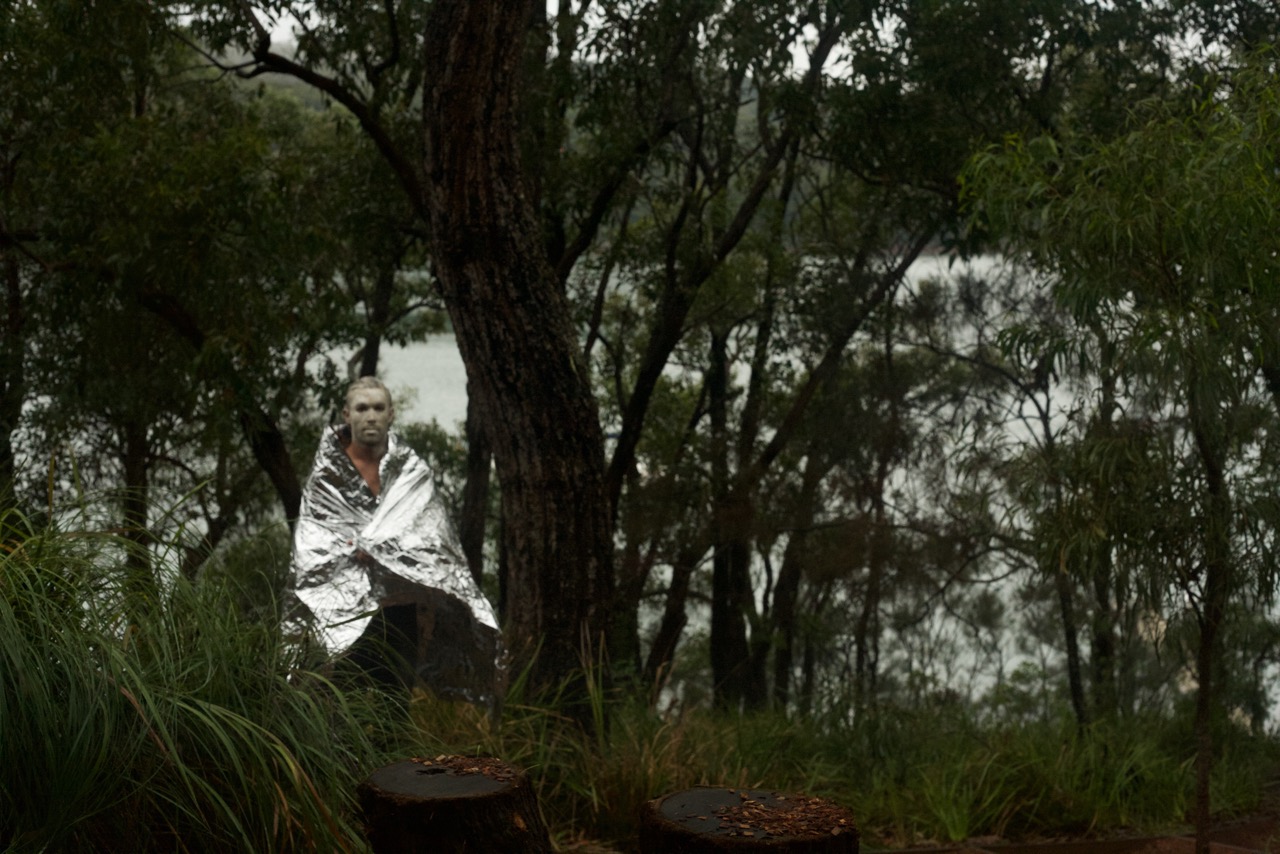
Of course, I was here to work, and that is what I did. The studio was set up and I allowed my impulses to guide my hand and my mind, weaving my way through the fog of ideas that followed me from the big smoke. With time and patience the fog lifts and one is able to better see, albeit in the distant recesses of one’s mind, the vague outlines of new ideas. Being a Worimi man, disconnected from my Country through displacement, abandonment and World Wars, I was deeply interested in creating work on Country and reconnecting with the old people long since past through creative communion. I found myself doing a lot of listening and looking. Watching the quivering leaves match the shifting tides, my mind floating like the pelican; at ease but with an acute attention to my surroundings, ready to pounce on a passing idea. I wanted to explore the blurry distinction between landscape and portraiture in Indigenous culture. To find the point where one can dissolve and become the trees and the wind and tides. I am not sure whether I got there, but the seed was planted, and will continue to grow like the flooded gums that reach resolutely upwards toward the sky. These ideas will continue to eddy and swirl around my mind until they decide they are ready to reach the surface.

Dean Cross, The view from here, July 2016, Gunyah

I found myself blindsided by other ideas also, which was a nice surprise and not wholly unexpected given the space one has to think. I did some early tests for a new series connecting hero narratives in Australian culture, but that’s as clear as it gets at the moment. Gunyah was a beautifully rich, grounding and restorative place. Blowing away cobwebs I wasn’t aware had gathered. I have my beautiful partner Bridgette to thank for this also, whose support and conversation were essential to my time and process, her adventurous spirit and willingness to explore with me absolutely crucial.
Thank you Gunyah for being you and doing what you do best.

Dean Cross
Gunyah residency report, July 2016

Dean Cross, We can be heroes - work in progress, July 2016, Gunyah